

Vocational Certification – Graduate competitiveness is a key issue in the rapidly evolving job market. Employers not only evaluate formal education levels but also consider whether graduates’ competencies align with industry needs. In this context, vocational education plays a strategic role because it focuses on the mastery of practical skills, and one of the tools frequently associated with enhancing the competitiveness of vocational graduates is certification of competencies.
According to an August 2025 data from Statistics Indonesia (BPS), there were 7.46 million unemployed people in Indonesia, an increase from the 7.28 million recorded in February 2025. BPS also noted that these figures had been adjusted in line with updated national population projections. This increase indicates that labor market challenges remain an issue that requires serious attention, particularly regarding workforce readiness and quality.
Read Also: Strengthening Vocational Human Resources to Build a Culture of Work Excellence
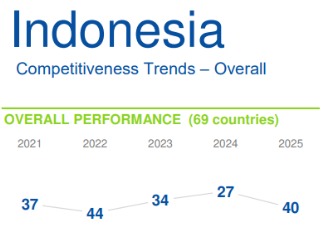
This employment situation is also linked to Indonesia’s global competitiveness. In the World Competitiveness Ranking (WCR) 2025 released by the IMD World Competitiveness Center, Indonesia’s competitiveness was ranked at 40th out of 69 countries, 13 places behind from the previous year’s 27th-place ranking (IMD, 2025). This decline indicates that national competitiveness, including the quality of human resources, still faces various challenges amid global dynamics.
In this context, workforce quality enhancement is an essential aspect in improving national competitiveness. Vocational education, as part of human resource development policy, addresses this need by ensuring that graduates’ competencies align with the demands of the job market. One of the instruments used is vocational certification, which ensures that graduates’ skills meet industry standards and needs. Thus, certification serves not only as recognition of competence but also as a means of strengthening the workforce’s competitiveness in an increasingly complex job market.
Vocational Education in Strengthening Human Resources’ Competitiveness
Several educational institutions emphasize the importance of transforming vocational education to strengthen the competitiveness of human resources. The Indonesian Vocational Education Program (Universitas Indonesia), particularly in the field of tourism, views certificate of competency as a crucial component of the learning process to support graduates’ readiness to enter the workforce. The certifications required to ensure each tourism graduate’s readiness include travel guides, Liaison Officer (LO), and English language proficiency such as TOEFL/TOEIC.
Therefore, certification of competencies is one of the supporting elements to ensure graduates have more measurable job readiness, although sustained quality in learning and industry engagement remain essential. This approach positions certification as part of the vocational education ecosystem. Certification is viewed as a complement to the educational process that helps ensure graduates possess competencies aligned with industry standards.
What Is Vocational Certification?
Vocational certification can be understood as a form of official recognition of an individual’s practical skills, granted through competency assessments conducted by authorized institutions and based on standards relevant to industry needs.
The Directorate General of Vocational Education of the Ministry of Primary and Secondary Education (Kemendikdasmen) explains that competency and professional certification are part of the strategy for strengthening human resources. Vocational certification is designed to recognize the competencies of students or graduates (from vocational high schools, polytechnics, and D1 diploma programs) based on standards aligned with industry needs. Through this mechanism, graduates’ competencies are not only reflected in their diplomas but are also verified through an objective and measurable assessment process, making them easier for the industry to understand and accept.
In general, vocational certification aims to improve graduates’ employability and competitiveness. Certification provides official proof of an individual’s applied skills in accordance with industry standards, while also opening broader opportunities in the job market, both nationally and globally.
In Indonesia, Competency and Professional Certification is conducted by Professional Certification Bodies (Lembaga Sertifikasi Profesi/LSP) to assess the competencies of individuals who have met specific competency standards in a particular field or profession. In this context, the competencies assessed are based on the Indonesian National Occupational Competency Standards (Standar Kompetensi Kerja Nasional Indonesia/SKKNI). SKKNI covers aspects of knowledge, skills, and/or expertise, as well as work attitudes relevant to the performance of duties and job requirements established in the workplace.
According to Coursera Micro-Credential Report 2025 survey, 97% of companies in Indonesia stated that certification strengthens a candidate’s application; another 97% have hired at least one certified professional in the past year; and 96% of companies are willing to offer a higher starting salary to certified professionals. This demonstrates companies’ strong interest in and appreciation for certified candidates.
For example, competency certifications in the tourism sector offer significant benefits, as the industry demands a workforce with measurable, standards-compliant skills. Tourism competency certifications are administered by LSP licensed by the National Professional Certification Board (Badan Nasional Sertifikasi Profesi/BNSP)), where the tested materials and fields are highly diverse, ranging from hotels, food & beverage, spas, MICE (Meetings, Incentives, Conventions, and Exhibitions), travel agencies, tour guiding, travel consulting, and the creative economy. For example, in the field of tour guiding, the topics or subjects to be tested include Tour Leader and Tour Guide. Through this certification, participants are expected to understand service standards, communication with tourists, and professional trip management. Competency certification for each individual is expected to become a key instrument in ensuring business professionalism, boosting industry confidence, and strengthening the overall competitiveness of Indonesia’s tourism sector.
The Relevance of Vocational Certification and Graduate Competitiveness
Graduates’ competitiveness in the employment market is closely linked to their ability to meet the needs and standards set by the industry. In vocational education policy, certification is positioned as a tool to ensure that graduates’ competencies align with these requirements. Vocational certification helps foster a shared understanding between educational institutions and the workplace regarding competency standards. Thus, graduates’ competitiveness is not only determined by their educational background but also by skills that can be verified or formally recognized. Through this standard, employers will have a clearer benchmark for assessing the readiness and capabilities of vocational graduates. Therefore, vocational certification contributes to improving graduates’ competitiveness in a more measurable and objective manner.
Vocational certificates are crucial in increasing the competitiveness of vocational education graduates. Various sources indicate that certification serves as a tool for recognizing competencies that bridges the gap between education and the needs of the workforce. However, certification is not the sole solution. Graduates’ competitiveness remains influenced by learning quality, industry engagement, and the consistency of education and labor policies. Through an integrated approach, vocational certification plays a role in strengthening human resources.